
Where and How Russians Fly Privately in 2026: The New Geography of Business Aviation
The RA-XXXX tail is banned from EU, UK, US and Canadian airspace. But the Russian business aviation market grew threefold from 2018 to 2024. Where the passengers used to fly (Nice, Courchevel, London) and where they fly now (Dubai, Istanbul, Baku, Tashkent) tells a specific story about how the market rewired itself.

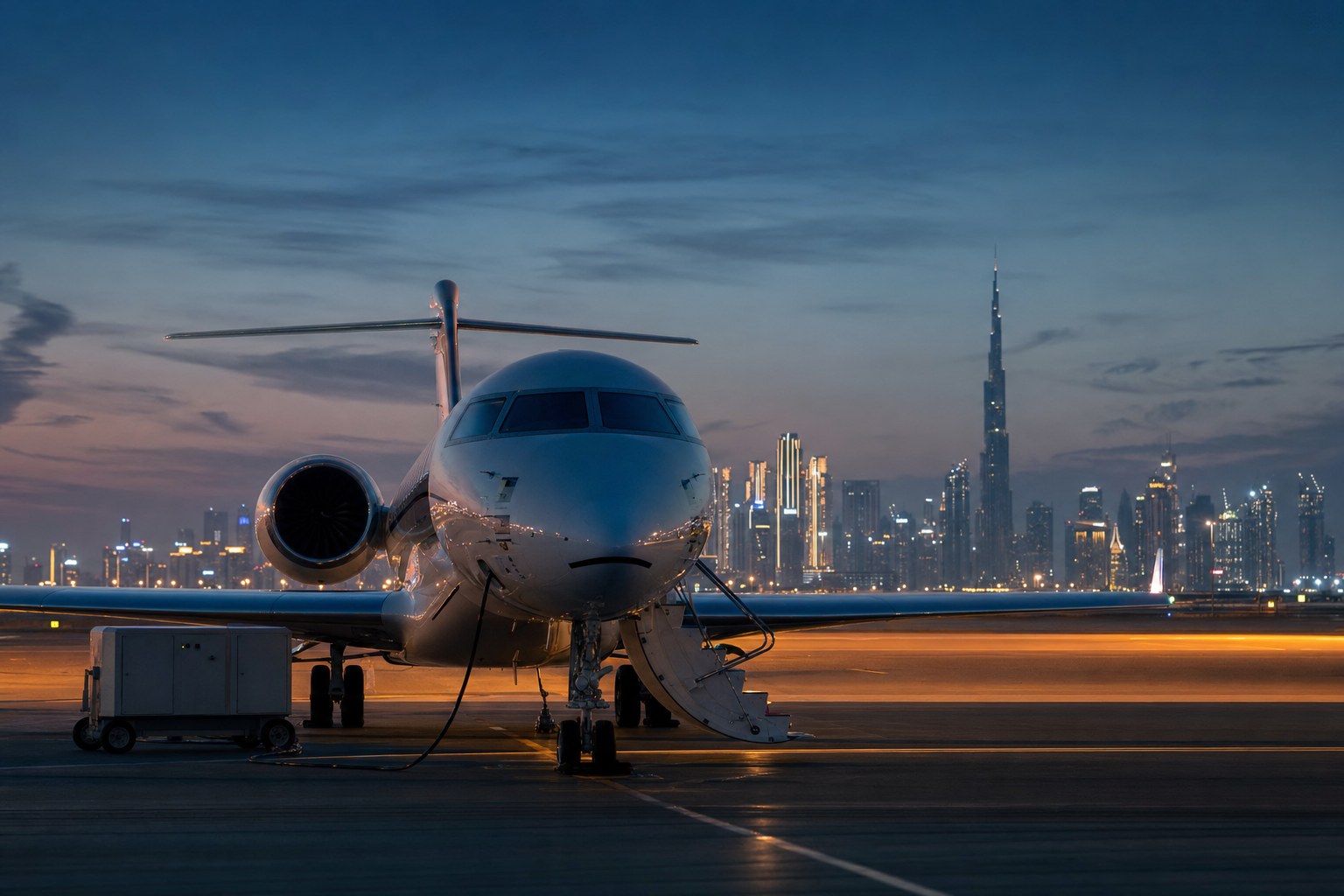
In the summer of 2021, if you tracked business jets over central Europe on a Friday afternoon, roughly one in six carried a Russian principal. Nice, Cannes, Farnborough, Geneva, Milan Linate, Bodrum. The map read like a wealth atlas, and Russian tail numbers were part of the furniture.
Since March 2022, aircraft on the Russian civil register (the RA-XXXX prefix) have been banned from the airspace of the European Union, the United Kingdom, the United States, Canada and a longer list of aligned states, under the aviation-package sanctions imposed after the full-scale invasion of Ukraine. Sanctions did not stop the Russian business aviation market. According to NeoAnalytics, cited by Russian industry publication JETVIP, the domestic Russian business aviation market reached ₽150 billion in revenue in 2024, roughly a threefold increase since 2018. Traffic did fall (down 32 percent in 2023 versus 2022, and 71 percent versus pre-COVID 2021) but revenue rose because prices doubled or tripled and the market rewired itself around a smaller pool of aircraft and a completely different destination map.
This is a look at where and how that flying happens in 2026, based on the aircraft registration data, market reporting and flight-tracking studies published this year. It is a market-analysis piece, not a service page. JetAlto does not sell into this network, and our compliance stance is stated at the end.
The three-tier system that emerged
What used to be a single market has fractured into three operational tiers, each with its own registration, aircraft type and destination set.
Tier 1 is the domestic Russian fleet. Aircraft on RA-XXXX registration, flown inside Russia and to sanctions-neutral neighbours. This is the biggest slice by flight count. JETVIP publishes what these charters actually cost in April 2026:
- Moscow to St Petersburg on a Hawker 850XP (8 seats): from ₽1,500,000 (roughly €14,000 at April rates)
- Moscow to Sochi on a Citation XLS+: from ₽2,200,000
- Moscow to Kazan on a Hawker 850XP: from ₽2,200,000
- Moscow to Yerevan on a Citation XLS+: from ₽3,200,000
- Moscow to Istanbul on a Challenger 350: from ₽4,500,000
- Moscow to Tashkent on a Hawker 900XP: from ₽4,800,000
Hourly rates for the fleet in service run from ₽300,000 per hour on a light Citation, up to ₽900,000 per hour on a Gulfstream G550. The domestic fleet has aged noticeably. Parts, maintenance events and MRO capacity now route through Turkey, the UAE and Kazakhstan rather than the European MROs Russian operators used before 2022.
Tier 2 is the friendly-flag fleet. Aircraft that used to fly on Bermuda (VP-B), Isle of Man (M-), Aruba (P4-) or Cayman (VP-C) registrations, but were pulled out of those registries after the airworthiness suspensions of March 2022. According to the Bermuda Civil Aviation Authority data as reported by www1.ru, Russian carriers deregistered 43 aircraft from Bermuda in 2025 alone (33 of them from Aeroflot), and 365 in total across 2022 through 2025. By December 2025 the Russian block on the Bermuda register had shrunk from 300 aircraft at the start of 2024 to 257. Some of those aircraft moved to full RA registration; some moved to newer offshore flags such as Kazakhstan (UP-), Turkey (TC-) and the UAE (A6-), which do not participate in Western sanctions and whose bilateral relationships still permit their tail numbers to enter Europe under normal conditions.
Tier 3 is the broker-intermediated Western fleet. This is the tier that surfaced in the Wall Street Journal investigation published in June 2026. The WSJ traced a pattern in which European aviation brokerage and management companies purchase new or used Bombardier and Gulfstream jets, register them in the UAE, Oman, Kazakhstan or South Africa (jurisdictions that do not participate in Western sanctions), and then make the airframes available to Russian principals. Aircraft valued in the tens of millions of dollars, mostly Bombardier Global 7500s and Gulfstream G650s, have been photographed at Moscow's Vnukovo airport carrying non-Russian tail numbers. Flight-tracking data cited by WSJ shows recurring flights between the UAE and Moscow through late 2025 and early 2026. WSJ characterises Western enforcement of the aviation sanctions package on this transfer channel as having "gone slack." We are not identifying named individuals here; anyone who wants those details should read the WSJ piece directly.
The new destination map
The 2022 New York Times investigation traced where Russian jets flew in the eight weeks after February 24 that year: the traffic redirected almost overnight from London, Nice, Geneva and Milan toward Dubai, Istanbul, the Maldives and Central Asia. Four and a half years later, that redirection has hardened into a stable set of corridors.
The routes that appear in JETVIP's April 2026 pricing tables, in the WSJ flight-track data, and in industry reporting are consistent:
- Moscow to Dubai (via Vnukovo or Sheremetyevo, into DWC Al Maktoum or DXB): the single busiest premium corridor. JETVIP quotes an Embraer Legacy 650 at ₽8,500,000 one-way from Moscow. Regular Empty-Legs on this lane, per JETVIP.
- Moscow to Istanbul (into Istanbul Sabiha Gökçen or Atatürk): both a destination in its own right and a transfer point. JETVIP quotes ₽4,500,000 one-way on a Challenger 350. Parking for a Russian-registered aircraft in Istanbul is quoted at ₽400,000 per day, a real operational cost that has become baseline.
- Moscow to Baku: Azerbaijan has become both a leisure destination for the top tier and a diplomatic transfer point; the WSJ tracked recurring Bombardier Global movements between Baku and Dubai during 2025.
- Moscow to Yerevan: Armenia sits inside the EAEU customs union with Russia and takes RA-registered aircraft freely. Yerevan Zvartnots is one of the two main jump-off points for onward travel to Europe under a change-of-aircraft scheme.
- Moscow to Tashkent: Uzbekistan has emerged as a serious business destination in its own right. JETVIP quotes ₽4,800,000 on a Hawker 900XP.
- Moscow to Riyadh, Doha, Abu Dhabi, Muscat: Gulf destinations across a broader range than Dubai alone.
- Moscow to Bangkok, Singapore, Kuala Lumpur: long-haul Southeast Asian destinations served by heavy-jet types such as the Falcon 7X and Gulfstream G550.
- Domestic corridors that got new momentum: Moscow to Kazan, Yekaterinburg, Novosibirsk and Vladivostok. With Europe closed and the southern Russian airports at Krasnodar, Rostov-on-Don and Anapa closed since 2022 (JETVIP lists 11 southern airports closed in total, requiring reroutes), internal Russian routes have absorbed volume that used to leave the country.
What is not on this list is any European destination on a Russian-registered aircraft. The workaround, when Europe is still the goal, is the Istanbul-transfer scheme. JETVIP describes it directly: the Russian-registered aircraft flies to Istanbul, passengers transfer inside the VIP terminal in about an hour, and continue on a European-registered aircraft (Malta 9H-, Isle of Man M-, Cayman VP-C, Aruba P4-, most commonly) to their European destination. Total added time is 2 to 3 hours over a direct flight. The economics are worse and the operator has to hold the second aircraft on the ground in Istanbul, but the scheme works.
The May 2026 airspace tightening
A development this year that gets less attention outside Russia is worth flagging. In late May, Russian authorities announced plans to ban civilian aircraft flights in the Moscow airspace zone from 0 to 5,100 metres, starting in early June 2026, across a geographic band stretching from the Belarus border and St Petersburg region as far east as Yekaterinburg, Samara and southern Russia.
The rationale is drone-defence: the March 2026 Kolomna incident, in which a light aircraft may have been shot down by Russian air defences responding to a drone attack, sharpened concerns about civilian aviation transiting active air-defence zones. The restriction hits helicopters, light aircraft and business jets. Regular scheduled airline traffic, medical evacuation and state-contract aviation are exempt. The aviation associations quoted by Euromaidan Press described the restriction as expected to remain in force "until the end of the special military operation," which is to say indefinitely. Some Russian aeroclubs have talked publicly about relocating operations east of the Urals.
Business aviation is not banned outright, because business flights typically climb above 5,100 metres inside the first few minutes of the departure profile. But airspace closures during drone events have become frequent enough that JETVIP's algorithm now factors real-time airspace status into its permission-to-fly calculation. Operating tempo inside western Russia is no longer predictable in the way it was in 2021.
What this means for European operators
The European operator side of this market has two categories of enquiry. The straightforward one is a Russian passport holder who does not appear on any sanctions list, is not politically exposed, holds assets outside Russia, and wants to charter a European-registered aircraft between European points. That enquiry is handled by any reputable operator with a normal KYC (know your customer) process: passport, source of funds, PEP screen, sanctions screen, ultimate-beneficial-owner check if a corporate booker is involved. The passport does not disqualify the enquiry. The sanctions and PEP checks do.
The complicated one is any enquiry involving a Russian-registered or Russia-linked aircraft, or any request to fly to or from Russian airspace. European operators cannot do this on their own certificates, cannot handle the aircraft, and cannot provide the fuel, catering, insurance or handling that a normal charter needs. The whole EU sanctions package on aviation runs through the operators, the aircraft register, the insurance, and the fuel supply, not just the passenger nationality. This is the mechanism that closed the market to Russian tails, and it has held.
The reporting in 2026 suggests enforcement on the aircraft-transfer side has weakened, particularly around the broker networks operating out of Vienna and third-country registries. Enforcement on the airspace side has not weakened. European air traffic control does not accept RA-XXXX flight plans and Eurocontrol filtering picks up sanctioned aircraft even when they attempt to file under a different registration if the physical airframe is on the sanctions list.
JetAlto's position
JetAlto operates as a pricing and charter provider based in Europe. We follow the EU, UK and US sanctions frameworks in full. We do not accept enquiries that would require service to a sanctioned individual, a sanctioned entity, an aircraft on a sanctions list, or a flight to or from an airspace under a Western aviation ban. We conduct KYC and sanctions screening on every enquiry before quoting, not after, and we decline enquiries that fail those checks without asking the client to explain. That is the compliance floor for any European operator. We regard it as a floor, not a ceiling: we also decline flights we can technically operate but which sit close enough to the sanctions perimeter that the operational and reputational risk is not worth the revenue.
None of what is described in this article is business we do. What we do offer, and this article is the reason for saying so, is a plainly-priced pay-as-you-fly service between European hubs and the Middle East, Africa, and the Americas, for principals whose compliance situation is straightforward and who want a European operator rather than a reseller. Our Dubai, Istanbul, London and Frankfurt route pages list the corridors we quote and the aircraft we deploy on each. If you want the mechanics of how legitimate charter pricing is built, our charter-pricing explainer covers the same numbers we quote to clients.
The picture in one sentence
The Russian business aviation market did not shrink. It rerouted east and south, split its fleet into three registration tiers, absorbed a Vienna-based broker network as its interface with the Western manufacturer base, and paid two to three times more for the privilege. The passengers who used to fly Nice fly Baku. The passengers who used to fly Farnborough fly Dubai. The corridors are new; the market volume is not.