
How Much Does It Really Cost to Charter a Private Jet in 2026? (Full Breakdown by Aircraft)
You get a five-figure quote for a two-hour flight. Where does the money go, which aircraft fits your trip, and which line items are actually negotiable in 2026?

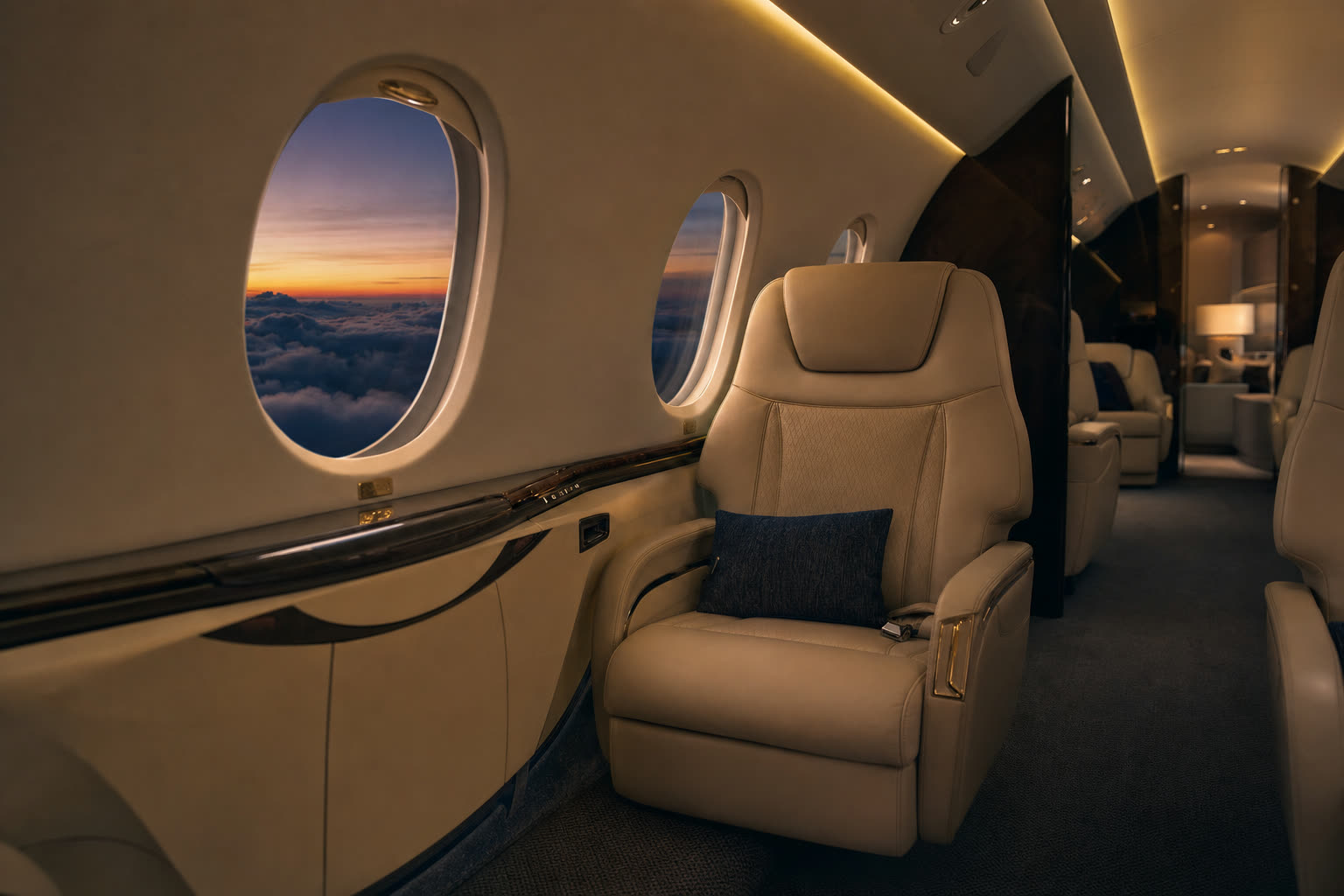
Charter quotes look opaque because they usually arrive as a single all-in number: 65,400 EUR, taxes included. The reality is that every quote is built from six distinct cost buckets, and the number that lands in your inbox depends heavily on which aircraft category the desk quoted, the season, and where the jet happens to be sitting the night before your flight. This 2026 update adds a hourly-rate table by category, three sample all-in trips, and the market context that has moved prices this year.
Looking for passenger taxes? Jump to our 20-country private jet tax examples, checked on 2 October 2026, with official references and worked calculations.
2026 quick reference: hourly rate by aircraft class
These are the ranges we see across the marketplace in mid-2026 for a well-maintained aircraft with a reputable operator (ARGUS Gold or better). Rates are per block hour and exclude landing fees, taxes and positioning.
| Category | Typical aircraft | Range (nm) | Pax | 2026 hourly rate (USD) |
|---|---|---|---|---|
| Turboprop | Pilatus PC-12, King Air 350 | 1,500–1,800 | 6–8 | $2,500 – $3,800 |
| Very light jet | Citation Mustang, Phenom 100 | 1,100–1,300 | 4–5 | $3,400 – $4,600 |
| Light jet | Citation CJ3+, Phenom 300, Learjet 75 | 1,600–2,100 | 6–8 | $4,200 – $6,200 |
| Midsize | Hawker 900XP, Citation Latitude | 2,600–2,900 | 7–9 | $6,000 – $8,200 |
| Super-midsize | Challenger 350, Praetor 600, Citation Longitude | 3,200–4,000 | 8–10 | $7,500 – $10,500 |
| Heavy | Falcon 900LX, Challenger 650, Legacy 650 | 3,800–4,700 | 10–14 | $9,000 – $12,500 |
| Ultra-long-range | Gulfstream G650ER, Global 7500, Falcon 8X | 6,700–7,700 | 13–19 | $13,500 – $22,000 |
Two important caveats. First, these are hourly rates — the total invoice equals hourly rate multiplied by block time, plus everything else in this post. Second, the same tail number can be quoted at very different rates depending on positioning: an aircraft five miles from your departure airport will price at the low end; the same aircraft ferrying in from another country prices at the high end.
Three real 2026 sample trips
London → Nice, one way, 4 passengers
A 2h flight on a light or midsize jet. Positioning is usually short (Farnborough or Luton to Nice is well trafficked). Expect:
- Phenom 300 (light jet): €13,500 – €17,000 all-in
- Citation Latitude (midsize): €18,500 – €22,500 all-in
- Same route as an empty leg during Cannes / Monaco season: €6,000 – €9,000 if you can flex your date by 24 hours
New York (Teterboro) → Los Angeles, one way, 6 passengers
Transcontinental. Needs a super-midsize (with a tech stop) or heavy jet non-stop, roughly 5h30 westbound.
- Challenger 350 (super-midsize) non-stop: $52,000 – $62,000 all-in
- Gulfstream G450 (heavy) non-stop: $68,000 – $82,000 all-in
- Global 7500 (ultra-long-range, empty return positioning): $95,000 – $120,000 if the aircraft has to return
London → Dubai, one way, 8 passengers
Ultra-long-range territory, 6h30 non-stop with a full cabin. Heavy jets can do it with a tech stop in Athens or Larnaca.
- Falcon 900LX (heavy) with tech stop: £85,000 – £105,000 all-in
- Global 7500 (ultra-long-range) non-stop: £130,000 – £165,000 all-in
The heavy-with-tech-stop option saves you 20–30% but costs 90 minutes on the ground in the Mediterranean. Time-cost tradeoff to make consciously.
The six buckets inside every quote
Every all-in number, however it is packaged, breaks down into these six line items. Ask your broker for the itemised version if you don't see them.
1. Flight time on the aircraft
The base cost is the aircraft's hourly rate multiplied by the total block time, which includes ferry legs and any positioning between the operator's base and your departure airport. On a two-hour passenger leg from London to Nice, you may be paying for four hours of aircraft time if the jet started the day in Munich. Ferry cost is the biggest hidden driver on short-notice charters and the one worth pushing back on: ask what the aircraft's next confirmed flight is and whether the ferry can be shared.
2. Landing, handling and parking fees
Airports charge private movements per landing and per hour of parking. Amounts vary wildly. London City is more than £3,000 for a midsize jet landing plus handling; a regional French airport can be under €400. Long parking (over 24 hours) adds meaningful cost. A quote should itemise these; if it doesn't, ask.
3. Fuel and 2026 fuel surcharges
Fuel is billed on the hourly rate, but a fuel surcharge appears when jet-A1 spikes above the operator's base assumption. Through 2025 and into 2026, most operators reset their base assumption twice; expect a surcharge line of 3–8% on European charters and 4–10% on North American charters during peak season. Sustainable aviation fuel (SAF) is now offered as a paid add-on by most reputable operators — typically a 15–25% premium on the fuel line for a 30% SAF blend. It shows up as a separate opt-in item on the quote.
4. Crew and cabin crew
Two pilots are mandatory. A cabin attendant is standard on super-midsize jets and above, optional on midsize, and rare on light jets. Overnight allowances (per diems) kick in when the crew stays away from base; on multi-day trips these can add several thousand euros. On heavy and ultra-long-range aircraft flying more than 8 hours, some operators now require an augmented crew (3 pilots), which adds a per-day rate.
5. Taxes
Tax treatment depends on the jurisdiction, aircraft and itinerary, not simply whether a flight is domestic or international. UK Air Passenger Duty also applies to taxable international departures, while the US uses different domestic and international air-transport tax rules (HMRC; IRS). The 20-country tax examples below separate per-passenger amounts from fare-based and whole-aircraft calculations.
6. Broker margin
Independent brokers earn 5 to 15 percent of the total. Operators quoting direct do not pay this margin but often do not shop competing operators for you either, so quote comparison is on you. This is the line item where a good broker earns its keep: shopping ten operators, catching hidden positioning, and forcing standardised terms.
Private jet taxes per person: examples for 20 countries
Tax reference checked: 2 October 2026. These examples cover the named passenger taxes and statutory levies, not the total tax bill or an all-in charter price. Each amount has an official reference beside it; airport handling, landing fees, VAT or GST, and other applicable charges can sit outside the figures shown.
Read each row as a specific scenario, not a universal country rate. Unless the row says otherwise, assume one adult, non-exempt passenger on a direct, one-way commercial jet charter, with no connecting-flight exemption. Aircraft weight means certified maximum take-off weight where that is the statutory test; a jet's seat configuration can matter even when only four people are flying.
The United States and Portugal examples allocate a flight-level amount across four passengers for budgeting. They are not flat statutory charges per person. Sweden and Ireland are included separately because their former air-travel taxes have been abolished, not because flying there is free of every tax or airport charge.
Europe: passenger taxes and private-jet-specific rates
| Country and example | Per person | What the amount covers |
|---|---|---|
| United Kingdom London to Milan | £142 | Higher-rate Air Passenger Duty for a jet of at least 20 tonnes equipped for fewer than 19 passengers, travelling to Band A. For the same qualifying aircraft, Band B is £1,097 and Band C £1,141 per person in the tax year starting 1 April 2026; these are not the rates for every smaller jet. Bands use the destination-country rules, not simply the distance flown (HMRC rates and aircraft criteria). |
| France Paris to Milan | €420 | Solidarity component only, for a non-scheduled commercial turbojet flight with a maximum operational passenger-seat configuration of 19 or fewer, to a European or similar destination. Intermediate destinations cost €1,015 and distant destinations €2,100 per person; turboprops have different rates. Other French aviation-tax components are not included (French civil aviation authority, 2026 solidarity notice). |
| Italy Milan to Dubai | €200 | Aerotaxi passenger tax on a leg over 1,500 km with departure and/or arrival in Italy. The other bands are €10 up to 100 km and €100 above 100 km up to 1,500 km; technical stops do not split the journey. This tax also matters when flying into Italy, and a qualifying return leg is a separate charge (Agenzia delle Entrate aerotaxi guidance). |
| Germany Frankfurt to Paris | €13.03 | Distance-class 1 aviation tax, following the reduction effective 1 July 2026; classes 2 and 3 are €33.01 and €59.43 respectively (German Customs rate change). The tax applies to commercial passenger transport departing Germany, rather than all owner-operated private flying (German Customs scope). |
| Austria Vienna to London | €12 | Air transport levy for a departure on an aircraft above 2,000 kg, with a destination at least 350 km away. A journey under 350 km attracts €30 instead; the statutory distance is great-circle distance, and aircraft up to and including 2,000 kg are exempt (Austrian Ministry of Finance, Air Transport Levy Act). |
| Netherlands Rotterdam to London | €30.25 | 2026 air passenger tax on a departing adult in a private aircraft above 4,000 kg. The tax authority lists Schiphol, Eindhoven, Groningen Eelde, Lelystad, Maastricht Aachen, Rotterdam and Twente as the relevant airports; transfer passengers are excluded (Dutch Tax Administration). |
| Belgium Brussels to Paris | €10 | Embarkation tax for a destination within 500 km of Brussels Airport's reference point. The corresponding rate above 500 km is €5 for this reference date, not the old €2/€4 split; the reference is Brussels Airport even when another Belgian airport is used (Belgian Finance rate notice; passenger-departure and distance rules). |
| Norway Oslo to London | NOK 61 | 2026 air passenger tax for a taxable departure with a final destination in Europe. The rate for other final destinations is NOK 350; connecting passengers and other statutory exemptions require separate treatment (Norwegian Tax Administration). |
| Denmark Copenhagen to London | DKK 30 | 2026 European-destination passenger tax; the medium and long-distance bands are DKK 260 and DKK 320 (Danish Tax Agency rates). This example is paid commercial charter on an aircraft above 5,700 kg or approved for more than ten passenger seats, not an owner's non-commercial flight (Danish Tax Council scope and thresholds). |
| Portugal 1,000 km departure; eight-seat aircraft; four passengers | €80 allocated | Illustrative share of a €320 whole-flight carbon levy: €2 × 10 × 8 seats × (1.0 + 1). The formula uses maximum factory seat capacity, not occupied seats, and great-circle distance in thousands of kilometres rounded to one decimal (ANAC calculation). It covers qualifying commercial and non-commercial departures in fossil-fuel aircraft with up to 19 passenger places; this example assumes no exemption or low-carbon-fuel reduction (Article 49-R). |
Americas: a fare-based tax is not a flat passenger fee
| Country and example | Per person | What the amount covers |
|---|---|---|
| United States One taxable domestic segment; US$20,000 taxable fare; four passengers | US$380.30 allocated | 7.5% of US$20,000 = US$1,500, plus four 2026 segment charges of US$5.30 = US$21.20; US$1,521.20 divided by four gives US$380.30. This is ordinary taxable charter between non-rural airports, not an owner-management or fractional-program exemption (IRS Form 720 instructions). International journeys have different rules; do not add domestic FET mechanically to every international charter (IRS Publication 510). |
| Canada Toronto Pearson to London | C$34.42 | Air Travellers Security Charge for chargeable travel outside the continental zone, at the rate effective from 1 May 2024 (Canada Revenue Agency rates). Assume a chargeable embarkation with an air carrier on a jet above 2,730 kg; using a private terminal does not itself establish an exemption from the listed-airport rules (CRA scope and exemptions). |
| Bahamas Nassau to Miami | B$29 | Departure tax per passenger shown in Bahamas Customs' private-aircraft clearance schedule. This is the passenger tax, not the separate inbound or outbound aircraft processing fees; the example excludes special permit exemptions (Bahamas Customs private-aircraft schedule). |
Asia, Oceania and Africa: departure taxes and border levies
| Country and example | Per person | What the amount covers |
|---|---|---|
| Australia Sydney to Auckland | A$70 | Passenger Movement Charge for a non-exempt international departure. The Border Force guidance expressly includes air charter operators and manual collection for small itinerant flights; passengers aged 11 or younger are exempt (Australian Border Force). |
| New Zealand International arrival at Auckland | NZ$25.07 before applicable GST | NZ$13.04 Customs levy plus NZ$12.03 biosecurity levy on arrival, using the schedule from 1 February 2026 through 30 June 2027. Departure has a separate NZ$3.62 Customs levy, also before applicable GST (New Zealand Customs levy schedule). The private-flight guidance includes private craft; non-approved airports can attract extra charges (private and non-scheduled flight guidance). |
| Japan Tokyo to Seoul; new booking after 1 July 2026 | ¥3,000 | International Tourist Tax per departure, increased from ¥1,000 on 1 July 2026. It is not limited to holidaymakers; the official FAQ includes private-jet payment procedures. Certain qualifying contracts concluded before the increase can retain ¥1,000, so the booking date and contract terms matter (Japan National Tax Agency FAQ). |
| Maldives Private jet departing Velana International Airport | US$960 combined | US$480 Departure Tax plus US$480 Airport Development Fee for a non-exempt adult private-jet passenger, at the rates from 1 December 2024. The departure tax applies across Maldivian airports; the additional development fee is specific to Velana, so US$960 is not a universal Maldives-airport figure (MIRA consolidated Airport Taxes and Fees Act). |
| South Africa Johannesburg to London | R190 | Air Passenger Tax for a chargeable international departure, including charter companies. The lower R100 rate applies to Botswana, Lesotho, Namibia and Eswatini; domestic flights are outside this tax (South African Revenue Service). |
Sweden and Ireland: two abolished taxes, not tax-free flights
| Country and example | Named tax per person | Why this is zero |
|---|---|---|
| Sweden Stockholm departure | SEK 0 | The Swedish air-travel tax was abolished from 1 July 2025. Old tables quoting that passenger tax should not be added to a 2026 charter quote; airport charges and any other applicable taxes remain separate (Swedish Tax Agency abolition notice). |
| Ireland Dublin departure | €0 | Ireland's former Air Travel Tax was abolished from 1 April 2014 (Irish Department of Finance, Annex 1). The abolition order remains identified in the Law Reform Commission's legislation index; this is not a claim that a Dublin charter has no other fees or taxes (Irish legislation index). |
What four passengers would actually add to the quote
For four non-exempt adults on the qualifying aircraft and journeys above, the UK Band A higher-rate APD totals £568, France's European-destination turbojet solidarity component totals €1,680, and the two Velana private-jet charges total US$3,840 (HMRC; French civil aviation authority; MIRA). These are calculations of the specified charges, not complete tax-inclusive flight prices.
Portugal behaves differently: the illustrative eight-seat, 1,000 km flight attracts €320 under the formula whether four or eight passengers occupy those seats. Its allocated cost is €80 each with four passengers or €40 each with eight; the statutory levy is still €320 for the aircraft movement (ANAC formula). A per-person comparison without the seat-capacity assumption would be misleading.
Questions to ask before accepting the tax line
- Which charge is this? Ask for the tax or levy name, rather than a single unexplained “taxes and fees” amount.
- What is the calculation? Request the passenger count, chargeable legs, applicable rate, and any taxable-fare or seat-capacity assumption.
- Is it already included? Confirm whether the headline charter price includes it, so the same charge is not added twice.
- What is still outside the total? Ask separately about airport fees, VAT or GST, customs attendance, and the return journey.
- Who confirms applicability? Have the operating carrier or its tax representative confirm the treatment of your actual aircraft, itinerary, travel date and passenger exemptions.
This reference is for planning, not individual tax advice or a guarantee of the final invoice. Rates and exemptions can change; a signed quote should identify the taxes included and any amounts still subject to confirmation.
What changed in 2026
Three shifts have moved the market this year and it's worth understanding them because they explain why quotes feel higher than 2023 memory.
- Fleet age. A wave of pre-owned aircraft transactions in 2022–2024 pulled several thousand jets into fresh 5-year maintenance cycles, and operators are recovering those costs through higher hourly rates. Rates on well-maintained midsize jets are up roughly 8–12% since 2023.
- Global 7500 and G700 delivery ramp. The ultra-long-range category is finally seeing new aircraft on the marketplace. Rates at the top of the market have stayed firm because demand exceeded supply for two years; only in H2 2026 are we seeing meaningful softening for spot G650ER availability.
- SAF mandate anticipation. EU ReFuelEU Aviation regulation requires 2% SAF blend from 2025 rising to 6% by 2030. Operators are pre-buying SAF at premium prices and passing the cost through. Expect this line item to grow.
Where the negotiation lever actually sits
You cannot negotiate fuel, taxes or landing fees; they are pass-through. You can influence positioning cost (by shifting departure day, departure time, or accepting an alternative airport 40 km away), and you can influence broker margin (by getting two or three parallel quotes). You can also often step down one aircraft category if your passenger count and baggage really fit — a Phenom 300 on London–Nice with four adults saves €5,000–8,000 over a Latitude and gets you there in the same 2 hours. Everything else is essentially fixed for the flight profile you asked for.
How to use this in practice
Before you accept a quote, ask three questions. First: what is the aircraft's positioning — where is it starting the day, and how much of my invoice is ferry? Second: which line items are pass-through and which are the operator's margin? Third: is there an empty leg on my route in a ±48 hour window? A good desk answers all three without hesitation. If yours doesn't, get a second quote.