
Which Private Jets Fly Europe Fastest: The Real Block-Time Table
Cruise Mach numbers sell aircraft. Block time is what you actually buy. On most European sectors the gap between the fastest jet and the slowest is under nine minutes.

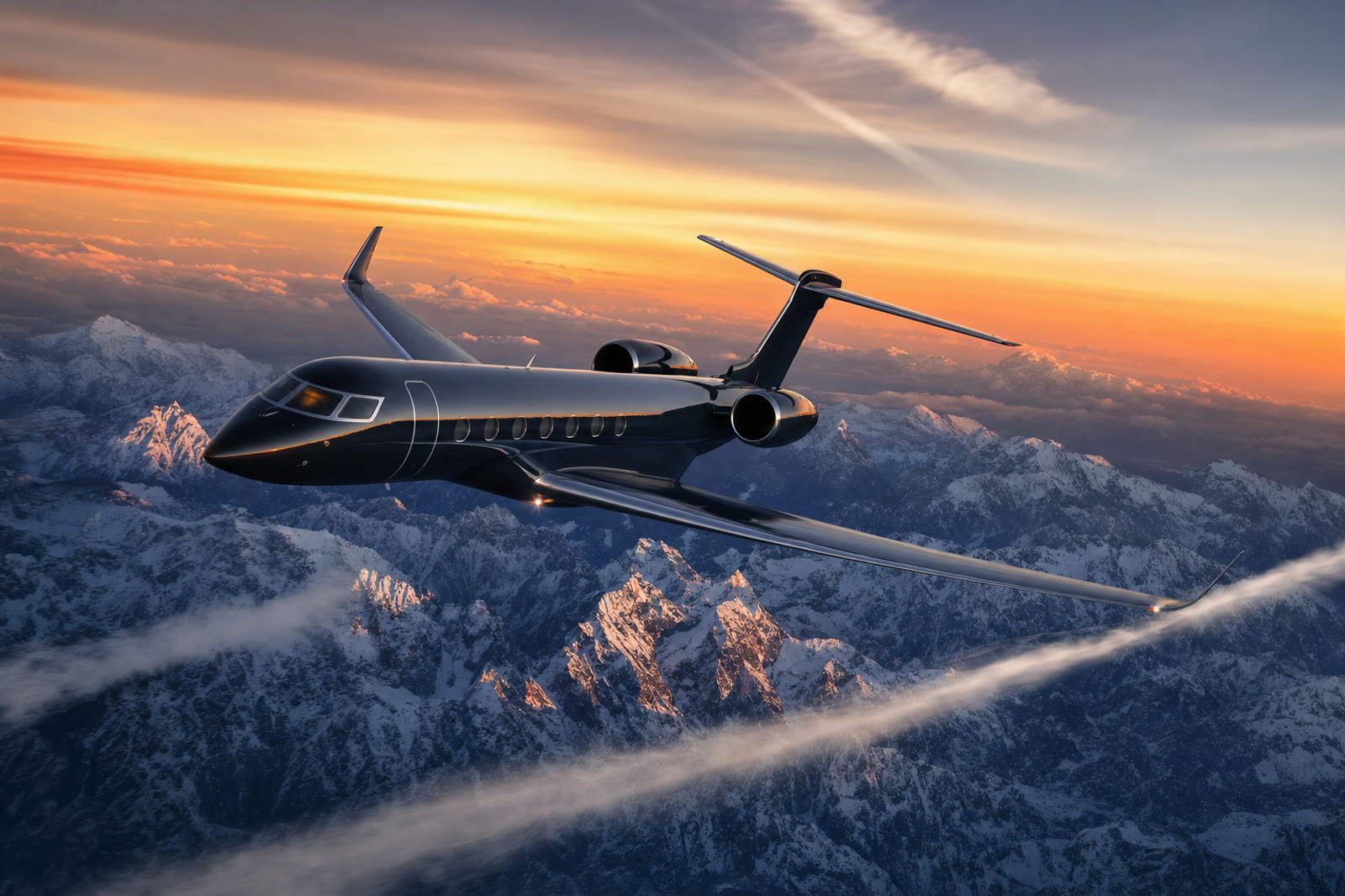
"How fast can we do London to Nice?" is the most common question we get and the hardest to answer honestly. The truthful reply is that a Global 7500 does it in about 1:36 and a Praetor 600 does it in about 1:44, and that the eight-minute difference costs roughly €10,000 on the invoice. Which is the correct aircraft depends entirely on what else you need that day.
This piece puts numbers on the whole grid: eight European sectors, seven aircraft, block times in HH:MM built from manufacturer cruise speeds with realistic taxi, climb and descent overhead, and 2026 euro block-hour rates alongside. The point is not to crown a winner. It is to show you where paying for Mach 0.90 buys you something and where it buys you nothing.
Why block time is not cruise Mach
A published cruise speed applies to the cruise segment only. On a 90-minute European sector, the cruise segment might be 45 minutes of that. Here is how a typical London to Nice rotation actually decomposes:
- Push and taxi at departure: 7 to 10 minutes at EGGW on a normal morning, longer at LFPB.
- Climb to initial cruise level: 18 to 22 minutes, during which average groundspeed is well below cruise TAS.
- Cruise: whatever is left, and this is the only part where the Mach number matters.
- Descent and approach: 15 to 18 minutes, more if the arrival into LFMN is holding.
- Taxi in: 4 to 6 minutes.
Add it up and roughly 45 minutes of every short European sector is spent doing something other than cruising. That fixed overhead is nearly identical for a super-midsize and an ultra-long-range airframe, which is why the fast aircraft cannot convert its speed advantage into schedule advantage until the sector gets long.
The published speeds we are working from
| Aircraft | Manufacturer speed | Range | Cabin length | Ceiling |
|---|---|---|---|---|
| Global 7500 | High-speed cruise Mach 0.90, top speed Mach 0.925 | 7,700 nm | 16.59 m | 51,000 ft |
| Gulfstream G650ER | High-speed cruise Mach 0.90, max Mach 0.925 | 7,500 nm at Mach 0.85 | 14.27 m | 51,000 ft |
| Falcon 8X | Cruise Mach 0.80, MMO Mach 0.90 | 6,450 nm | 13.00 m | 51,000 ft |
| Falcon 7X | Cruise Mach 0.80, MMO Mach 0.90 | 5,950 nm | 11.91 m | 51,000 ft |
| Challenger 350 / 3500 | High-speed cruise Mach 0.82 | 3,400 nm | 7.68 m | 45,000 ft |
| Citation Longitude | Maximum cruise 483 ktas | 3,500 nm | 7.68 m | 45,000 ft |
| Praetor 600 | High-speed cruise 466 ktas | 4,018 nm | 8.41 m | 45,000 ft |
Sources for these figures are the manufacturers: Bombardier Global 7500, Gulfstream G650ER, Bombardier Challenger 3500 and Textron Citation Longitude. Dassault's own family data sheet gives the Falcon 7X 5,950 nm at Mach 0.80 cruise with an MMO of Mach 0.90, a 5,710 ft balanced field length and a 2,070 ft landing distance (Dassault Aviation); Eurocontrol's aircraft performance database confirms FL510 and Mach 0.90 for the type (Eurocontrol APD). Praetor 600 figures of 4,018 nm and 466 ktas high-speed cruise come from the published Embraer type data (Praetor 600 specification sheet).
The eight-route block-time table
Note one important thing before you read it. The Falcons cruise at Mach 0.80 in the book, not Mach 0.90, and that is a fuel-efficiency choice, not a limitation. In practice European operators push them harder on short sectors. The figures below use a realistic Mach 0.85 for the 8X, which is what the airframe actually flies on short European sectors.
| Route | Great circle | Global 7500 | G650ER | Falcon 8X | Challenger 350 |
|---|---|---|---|---|---|
| London EGGW to Nice LFMN | 579 nm | 1:36 | 1:36 | 1:40 | 1:43 |
| London EGGW to Ibiza LEIB | 784 nm | 2:01 | 2:01 | 2:07 | 2:11 |
| Paris LFPB to Geneva LSGG | 221 nm | 0:51 | 0:51 | 0:52 | 0:53 |
| Frankfurt EDFE to Zurich LSZH | 150 nm | n.a. (runway) | n.a. (runway) | 0:43 | 0:44 |
| London EGGW to Athens LGAV | 1,319 nm | 3:09 | 3:09 | 3:19 | 3:25 |
| London EGGW to Dubai OMDB | 2,969 nm | 6:36 | 6:36 | 6:58 | Tech stop required |
| Geneva LSGG to Samedan LSZS | 157 nm | Case by case | Case by case | Case by case | 0:45 |
| Paris LFPB to Cannes LFMD | 376 nm | 1:10 | 1:10 | 1:13 | 1:15 |
Methodology: great circle distances computed between published airport coordinates, then increased by 8% to approximate real ATS routing. Airborne time is track distance divided by manufacturer high-speed cruise TAS, plus a fixed 9 minutes to represent climb and descent inefficiency and 14 minutes of combined taxi. Figures are planning estimates for a still-air day, not guaranteed schedule times. Westbound winter sectors against a strong jet stream can add 20 to 40 minutes on the Athens and Dubai legs; eastbound can subtract a similar amount. Confirm against operator performance data before relying on any figure here.
Two cells need explaining. EDFE Egelsbach has a 1,400 m runway, so ultra-long-range types are not going there regardless of how fast they cruise. Samedan LSZS is a 1,840 m by 40 m runway at 5,600 ft elevation with no runway or approach lighting, no night operations, daylight-only RNAV approaches and a mandatory pilot familiarisation requirement, per the airport's own pilot briefing (Engadin Airport). Whether a G650ER can legally land there on a given day is a performance calculation involving temperature, weight and operator approval, not a spec-sheet question. That is what "case by case" means.
What the table actually shows
On Paris to Geneva the difference between the fastest and slowest aircraft in the set is two minutes. On Frankfurt to Zurich it is one minute. Anyone paying an ultra-long-range premium to save 60 seconds on a 150 nm sector is buying cabin, not speed, and should say so out loud.
The crossover is somewhere around 1,300 nm. On London to Athens the spread opens to 16 minutes. On London to Dubai it opens to 22 minutes between the Global 7500 and the Falcon 8X, and the Challenger 350 drops out of the comparison entirely because a 3,400 nm book range against a 3,207 nm track distance plus NBAA reserves is not a flight plan anyone will sign.
2026 block-hour rates in Europe
Speed only matters against price. Jet Supply's Q3 2026 European price index, compiled from 66 individually priced aircraft in the European charter market, puts all-in block-hour rates at €8,900 to €15,300 for super-midsize types such as the Challenger 350 and Praetor 600, €12,200 to €18,400 for heavy jets, and €14,300 to €22,500 for ultra-long-range aircraft including the Global 7500, G650 and Falcon 8X. The same index prices London to Paris on a light jet at €8,300 all-in for a 52-minute sector, and London to Nice at €13,000 on a super light with a 1:42 block time and an effective €7,600 per block hour (Jet Supply European Private Jet Charter Price Index, Q3 2026).
| Class | Example types | 2026 EUR block hour | Mid-band |
|---|---|---|---|
| Super light | Pilatus PC-24, Citation XLS+ | €6,400 to €9,900 | €8,150 |
| Super midsize | Challenger 350, Praetor 600 | €8,900 to €15,300 | €12,100 |
| Heavy | Challenger 650, Falcon 900 | €12,200 to €18,400 | €15,300 |
| Ultra long range | Global 7500, G650, Falcon 8X | €14,300 to €22,500 | €18,400 |
Run the London to Nice case. A super-midsize at the €12,100 mid-band over a 1:43 block is roughly €20,800. An ultra-long-range at €18,400 over 1:36 is roughly €29,400. You are paying about €8,600 to arrive seven minutes earlier. Nobody buys that trade for the time. They buy it for the cabin, the bed, or because the same aircraft is continuing to New York that evening.
Where each aircraft actually wins
The Global 7500 wins on long sectors with weather in them. Its 7,700 nm book range gives it the fuel to accept a poor routing, hold, and still make the destination, and on a headwind day that reserve is worth more than any Mach number. Our G650 versus Global 7500 comparison goes deeper on that trade, and our piece on ultra-long-range versus heavy jets covers the class boundary.
The G650ER wins on the pure point-to-point ultra-long sector where the mission is defined in advance and nothing changes. Same speed, tighter cabin, and in the European charter market usually the easier of the two to source.
The Falcon 8X and Falcon 7X win on runway. A 6,000 ft balanced field length for the 8X and 5,710 ft for the 7X, with a 2,070 ft landing distance on the 7X, open up fields that Gulfstreams and Globals cannot use at weight. The trijet also gives you an engine-out margin that matters on alpine and island approaches. For a St Moritz or Corsican mission, that is the whole argument.
The Challenger 350, Citation Longitude and Praetor 600 win on everything under 1,000 nm, which is the overwhelming majority of European charter demand. On a Geneva to Nice or Paris to Milan sector they lose four minutes and save you five figures.
Frequently asked questions
Are these block times guaranteed?
No. They are planning estimates from manufacturer speeds and modelled overhead. Actual block time depends on ATC routing, slot, wind, weight and departure airport congestion.
Why does the Falcon 8X show Mach 0.85 when Dassault publishes Mach 0.80?
Because Mach 0.80 is the long-range cruise figure used to certify the 6,450 nm range. On a 600 nm European sector the aircraft is not range-limited, and operators fly it faster. MMO is Mach 0.90.
Is a Global 7500 ever the wrong answer on a European sector?
Frequently. Any sector under 500 nm where the destination has a short runway, tight parking or a landing fee scaled by MTOW, and any sector where the aircraft is chartered on a one-way basis and has to reposition empty afterwards.
Which of these types can reach Dubai from London nonstop?
The Global 7500, G650ER, Falcon 8X and Falcon 7X all have the book range. The super-midsize types do not, at 2,969 nm great circle before routing and reserves.
Do these numbers include positioning?
No. If the aircraft is not already at your departure field, you pay for the empty leg to get it there, and on a one-way charter that can exceed the revenue sector itself.
Want the real number for a specific date and pair of airports? Send us the routing and we will quote the block time from operator performance data rather than a spec sheet, and show the positioning separately.