
Courchevel Altiport: The Hardest Legal Runway in Europe, Explained in 90 Seconds
537 metres of runway, 18.6 percent uphill, no go-around option, and one of the busiest private aviation destinations in the Alps. How Courchevel altiport actually works.

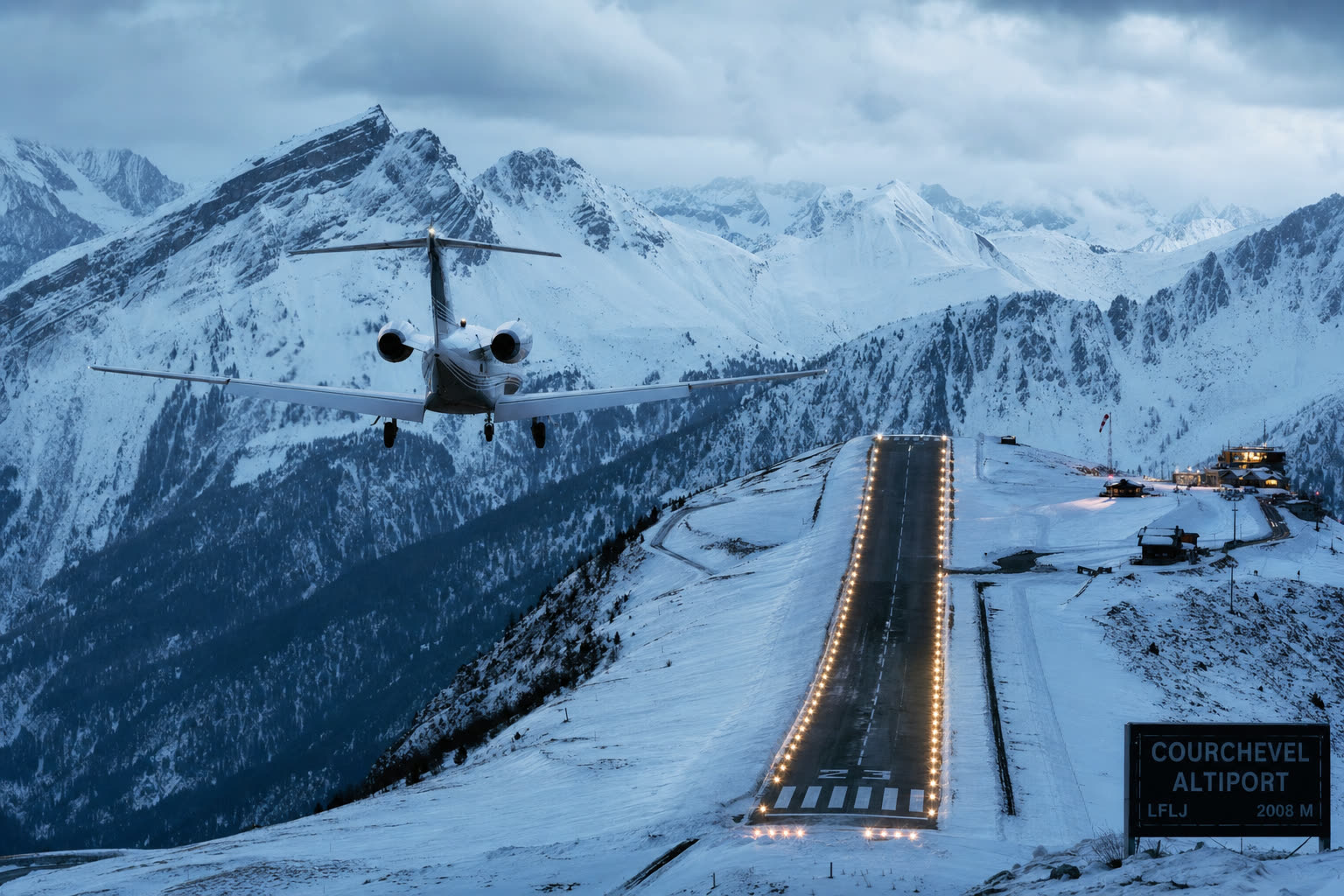
Courchevel altiport (ICAO: LFLJ, IATA: CVF) is 6,588 feet above sea level, sits on a Savoie mountain shoulder above the 1850 ski resort, and has a runway that goes uphill at an 18.6 percent gradient. It is not the highest airport in Europe and it is not the shortest, but no other legal commercial airfield in Europe combines the two constraints in the same way. Here is what makes it special and what it means for anyone chartering into or out of it.
The runway
Runway 22 is 537 metres long, 40 metres wide, and climbs 18.6 percent from threshold to end. That is roughly one metre of vertical rise for every 5.4 metres forward. In everyday terms, the far end of the runway is 100 metres higher than the threshold. Landing traffic approaches uphill; departing traffic accelerates downhill. There is no runway 04 in operational use. Once you have committed to the approach, you cannot go around.
Why you cannot go around
Standard airport operations assume that if an approach is unstable, the pilot can add power, retract flaps, and climb away for another attempt. At Courchevel, terrain rises immediately past the threshold in three directions and the aircraft would not out-climb it in time. Pilots make the commit-to-land decision at a fixed decision altitude on the approach, and after that point, they are landing. This is why the certification requirement to fly into CVF is a specific pilot rating, not just an aircraft certification.
Which aircraft can land
The runway length and gradient rule out most jets. Practically the only turbine aircraft that regularly serve CVF are:
- Pilatus PC-12: the workhorse of the altiport, single turboprop, six to eight passengers.
- Pilatus PC-24: the only jet that regularly operates in and out of Courchevel commercially, and only with a specifically trained crew.
- King Air 200 / 350: twin turboprop, popular for family groups.
- TBM 850 / 910 / 960: single turboprop, four to five passengers.
Helicopters, of course, land at the adjacent helipad without any of these constraints.
The weather constraint
CVF is a visual flight rules airport. That means no instrument approach, no autopilot-flown descent, no landing in cloud. Pilots need to see the runway and the terrain before they commit. In practice this means:
- Operations run roughly 08:30 to 17:00 local, depending on season and light.
- No night operations. Ever.
- Low cloud, fog, or heavy snow shuts the airport. Diversion to Chambery (CMF) is the standard fallback, and CMF is a 90 to 120 minute ground transfer from Courchevel 1850.
What this means for a client
Three practical implications.
First, book a jet that can actually land there. Do not accept a quote for a Citation or a Phenom into CVF from a broker who is fudging it. If the aircraft cannot land, you land at CMF and lose two hours of transfer.
Second, always book a weather diversion buffer. Any charter into CVF in December through March needs contingency for a diversion to CMF or Chambery-Aix-les-Bains, plus a ground team standing by. Reputable operators quote this in from the start.
Third, expect a briefing. First-time passengers on the approach into CVF should know it will feel steep. The final descent is a steep visual approach at roughly 6 to 8 degrees of pitch, versus the standard 3 degrees at a normal airport. First-timers who do not know this coming get anxious. Pilots usually mention it during boarding. If yours does not, ask.
The one photo that explains it
Search image results for "Courchevel altiport uphill runway" and you will see a single frame that captures why every aviation channel on YouTube has a video about this place. The threshold sits below the end. Aircraft appear to land on a ski slope. That is not a camera trick, that is the actual runway.
Why it exists
Courchevel altiport opened in 1961, hand-carved into the mountainside during a period when French Alpine resorts wanted year-round premium access. It has never been meaningfully lengthened or reconstructed because there is nowhere to put the extra metres. The runway is what it is because the mountain is what it is. Every operator flying into CVF has adapted to the runway, not the other way around.
Which is also the reason a Courchevel flight remains one of the more memorable ways to arrive at a European ski week. If you are planning a winter charter, our London to Courchevel, Paris to Courchevel, and Zurich to Courchevel route pages have current pricing and aircraft options.