
What a Private Jet Actually Smells Like: 8 Things the Brochure Does Not Mention
Every charter brochure sells the same photo: crystal glasses, cream leather, a smiling attendant. The real cabin is more interesting and slightly weirder.

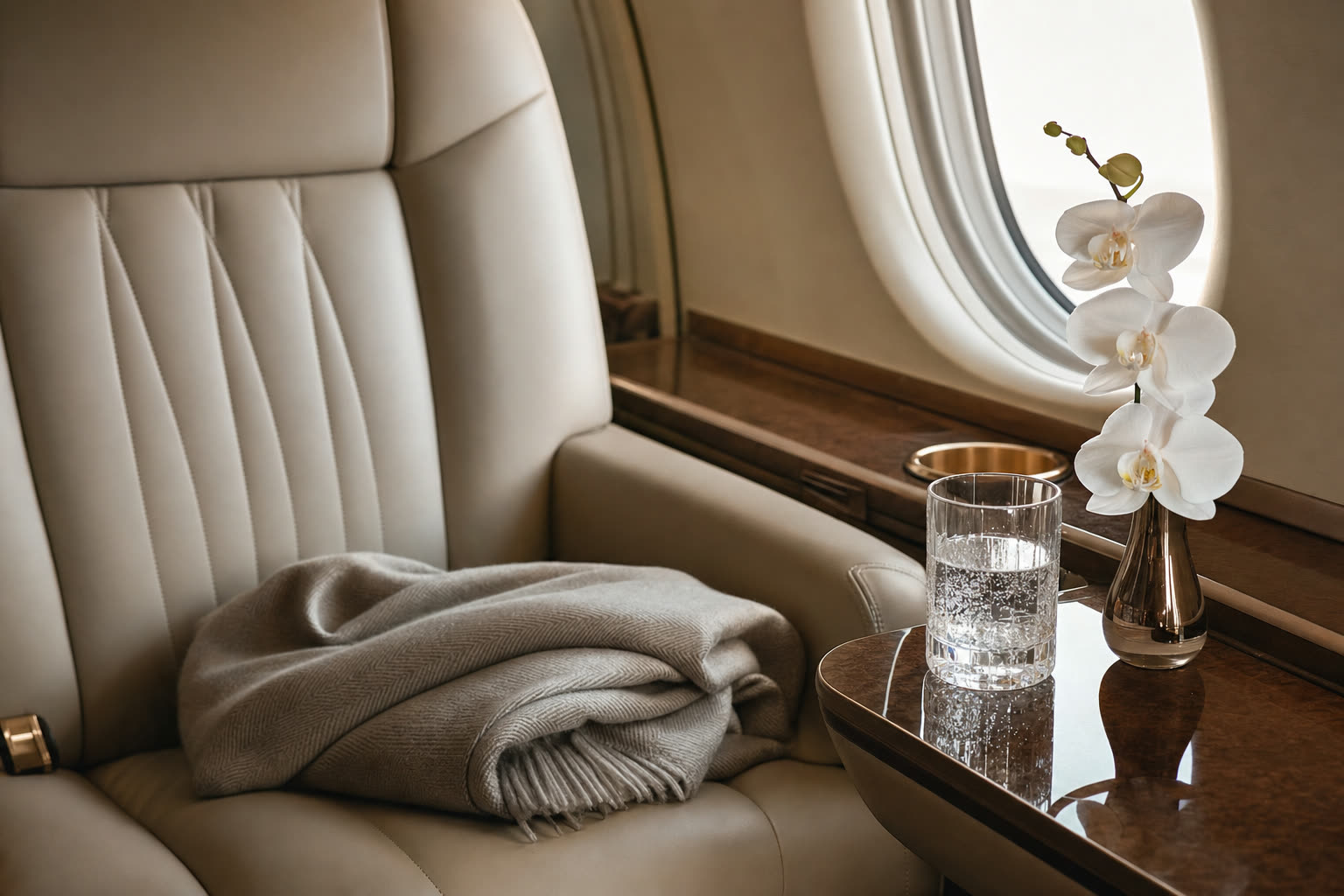
Charter marketing has to sell an image. That image is always the same: cream-leather seats, a glass of champagne, an attendant in a fitted uniform. Real cabins are quieter, smaller, and more idiosyncratic than the photos suggest. Here are eight sensory details that surprise most first-time charter clients.
1. There is always a faint smell of Jet-A1 for the first two minutes
Ground handling means the aircraft has been sitting near fuel bowsers and near its own APU exhaust. The moment the door opens on the tarmac you get a whiff of kerosene that fades within a minute or two of cabin airflow. It is not unpleasant, but it is real. Newer aircraft with better filtered APUs (Global 7500, Praetor 600) have almost none of it. Older midsize jets have a little more.
2. The seats are firmer than you expect
Business-class cabin seats are pillowy on commercial widebodies because passengers sit in them for eight to fourteen hours. Charter seats are firmer because 90 percent of trips are under three hours and firmness supports better posture. Long-range aircraft (Global, Gulfstream G650, Falcon 8X) have softer seating because they are designed for actual sleep.
3. Midsize jets are surprisingly loud on climb-out
Below 15,000 feet on a Citation Latitude or Praetor 500, you can hear the engines clearly at the back of the cabin. Not shouting-loud, but definitely present. At cruise altitude, above 41,000 feet, the same aircraft is remarkably quiet. Heavy jets and long-range aircraft are quiet through the whole climb because they have more mass and thicker fuselage lining.
4. The toilet is a real toilet
Long-range aircraft have full lavatories with washbasins, mirrors, and closing doors. Midsize jets typically have a curtained, self-contained lavatory at the aft. Light jets often have a belted lav seat that doubles as an emergency crew seat. If a real toilet matters to you (or you are travelling with children), specify it in your quote request. Do not assume.
5. There is no boarding pass
You walk from your car to the aircraft. Handling staff take your ID, note the passport details for the flight plan, and that is it. On international departures you do get a border-control check but it is done at the FBO desk in about 90 seconds. First-time charter clients often stand around after the check waiting for something else to happen. There is no something else.
6. The pilots come and say hello
Two pilots operate the aircraft. On virtually every charter, at least one of them (usually the captain) comes into the cabin during boarding, introduces themselves, confirms the flight time, and asks if you have any preferences on the cruise altitude (some passengers prefer low cruise to save minutes on short-haul, others want smooth air above 40,000 feet). This is standard, not premium.
7. The catering is not what you think
Unless you specifically request a hot catering setup with a chef-prepared menu in advance, charter catering is typically a cold platter, a fruit selection, a pastry option, coffee and tea, and a drinks selection you specified in the booking. Hot catering exists but it needs 24-hour lead time and a real budget line. On a two-hour flight, most clients order coffee and sandwiches, drink the coffee, and eat one bite of the sandwich.
8. It smells like the client after 30 minutes
The cabin volume is small. Whatever perfume, cologne, food, or scent you bring on board is the entire olfactory environment of the flight. This is fine on a corporate charter with three people who have worked together for ten years. It is less fine on a two-passenger romantic weekend where one person put on too much aftershave in the car. The cabin does not dilute it. Recirculation is fast but not that fast. Consider light scent choices.
Why any of this matters
Charter is about the experience of not queueing, not being scanned, not being announced at, and having the aircraft depart when you are ready. It is much less about the exact configuration of leather trim or the specific champagne brand. The marketing tries to convince you it is about the champagne. The reality is that clients remember the door-to-door time, the pilot who came and said hello, and the fact that they got to their meeting on time or their vacation started an hour earlier. Not the champagne.